Monday, 13 April 2026

Amazon, Kindle, and why e-Books are Off My Agenda

My annoyance regarding Amazon’s dickishness over e-books has rekindled this blog.

So, I’ve got an old version of the Kindle, and Amazon, who are suffering greatly with their finances, have decided that old versions like mine will no longer be supported.


Affected devices include Kindle 1st and 2nd Generation, Kindle DX and DX Graphite, Kindle Keyboard, Kindle 4, Kindle Touch, Kindle 5, and Kindle Paperwhite 1st Generation.

To minimize any disruption, we're offering a promotional code for 20% off select new Kindle devices … as well as a £15 eBook credit … after purchasing a new device (valid through June 20th, 2026, 11:59pm PST - Terms and Conditions apply)


Now, you might say that technology is brimming with built-in obsolescence (the vileness of smartphones being the most obvious example). But I would counter that the e-book was intended to replace a physical book. I’ve got an old copy of Rebel, by Bernard Cornwell, on my desk right now. The paper hasn’t combusted, the spine hasn’t shattered, and I don’t need a micro-transaction for a code to unlock it. It works just fine. It’s from 1994, a happy time when AI was fictional and nobody was trying to impose digital ID on us.

E-books, to my understanding, were technically just renting a book for life. But as they’re about 50-80% the cost of a proper book, have immediate delivery, and (most importantly for me) zero extra storage space, that’s fine for fiction and the occasional history. 

But here’s the kicker. If you need to replace your e-reader to actually access them or buy more then it critically undercuts the value of the e-book. At the time of writing, Amazon has Kindle devices (e-readers) ranging from £95 to £380. 

How long will the cheapest ones last before being replaced? No idea. Could be 3-4 years, could be a decade.

Meanwhile, my copy of Rebel (nearly finished it, very much enjoying the climax) is perfectly functional.


Why’s the old Kindle now obsolete? Probably for the same reason Amazon disabled downloading e-books via a wired connection, which is how I used to transfer files. For the convenience and financial advantage of the firm. I don’t mind a business making money, I do mind them needlessly turning my e-reader into a brick* so they can gouge cash from me.

*It still works, for now, but any problems won’t be remedied and a factory reset won’t mend it.


The promotional code and an e-book credit (contingent on buying a new device within a short time frame, because you’ve got to milk the Fear Of Missing Out) is up there with the Government’s new plan to ‘improve’ self-employed people’s lives by making tax returns, over a certain threshold, quarterly and require third party software.

Don’t make my life worse then claim it’s somehow an improvement. Don’t make my e-reader unable to download new books because you want more money then pretend a discount or credit makes up for it. Unless you want to give me a 100% e-reader discount, of course.

But, hey, you’ve got to find the money to fund another season of Rings of Power somewhere, right?

The irony here is that this, in a very small way, is just going to cost Amazon. Because I only have a Kindle all my e-books (most of the fiction I bought) was from them. When it comes to physical books I tend to split it between Amazon and Waterstones. And the latter have never screwed me over.

I’m not buying another e-reader for the privilege of being able to buy more e-books in the same way I’m not subscribing to Prime for the privilege of being able to shop at Amazon.

Thaddeus

Thursday, 12 September 2024

Battle Brothers – First Impressions (PS5)


It’s been a little while since my last blog, and this one is a little bit unusual. While I’ve done first impressions on video games before, this game dates back to 2017 for the initial release and was made by a tiny team (half a dozen or so). I only found it by going out of my way to seek interesting tactical/strategy games. At the time of writing it’s on sale (PSN) with 60% off until 25th September.

So, what is Battle Brothers?

The player is the captain of a small mercenary company. Combat is tough (as recommended I’m playing on Beginner and am fortunate to have only lost a couple of raw recruits so far) but a lot of fun. The company can be named (I went for The Black Company) and its banner picked from a selection.

Battles are turn-based events take place as part of missions the player is sent on, random encounters, or choosing to attack roaming brigands you happen to see. The overworld is procedurally generated and the graphics are on the retro side (for both the overworld and combat). However, it’s easy to navigate and while the tutorial is lacking in detail it’s fairly intuitive to learn what’s what.

Missions can help a player alter the world by befriending cities and gaining renown, defeating bandits and cutting down supply raids (increasing available goods in town markets and reducing prices), or you can go evil and attack the innocent. On one mission, to retrieve a stolen item, I had the option after winning the battle to return the item to its rightful owner or take a larger payment to hand it over to the man who commissioned the theft.


Towns vary in size, all having markets for basic goods and potential new mercenaries. Larger towns might have barbers where appearances can be customised, taverns for gossip and drunken delights, and specialist stores with better gear. Bear in mind there’s no player-character and death is permanent. In rare cases, a ‘dead’ character might recover but with a permanent and severe injury.

Weapons act in different ways. Crossbow and bows are both ranged but crossbows cost less AP to shoot yet require reloading. You can also hit your own guys, but if right behind a shield wall (which it’s a good idea to make) and shooting at enemies only 2 spaces away this risk is negated. Some melee weapons have reach. Wielding a one-handed weapon with two hands offers an advantage but at the downside of no shield (probably not worth it, I suspect).

In addition to helpfully looting weapons, armour, and supplies, certain goods might be found which have varying prices based on where you try to sell them, adding a little touch of mercantile to the mercenary company.


On levelling up the player determines 3 of about 8 potential stats to increase. Mercenaries with stars (1-3) get higher boosts to those stats. There’s also 1 perk per level the player picks, and each new level unlocks a new row of potential perks. It’s simple, easy, and works well. In addition to that, individual mercenaries can have bonuses or drawbacks naturally (such as being greedy and eating more supplies, or being lucky). Short-term injuries are fairly common and heal over a few days. All this adds up to make mercenaries their own characters, augmented by when they do something wrong (I had to stop one guy assaulting the local peasants, but had the option to just let him do it).


The writing’s high quality (the chap who did it has apparently written some books which I may check out when my comical to-read pile is more molehill than mountain) and the pace of the battles is pitch perfect. The tutorial could be more helpful and the challenge is on the high side, or seems to be (I’m just a few hours in on Beginner so it’s difficult to be sure but it’s practically the only thing every review agrees on).

Based on early impressions, I can recommend getting at least the base game for £12. I’m going to keep playing, with a view to probably buying the DLC bundle before the sale expires.


Thaddeus

Friday, 10 November 2023

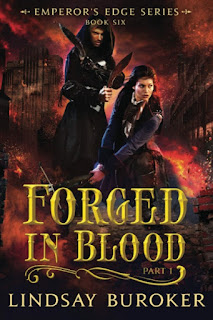
Review: Forged in Blood I (Emperor’s Edge book 6), by Lindsay Buroker

It’s been a little while, but good to get back to the Emperor’s Edge series which is a little outside my standard high/classic/medieval fantasy (I’ve also been binge-reading The Black Company, which I might collectively review once I finish Soldiers Live).

Obviously there are spoilers for previous entries, though I’ll try and keep those and current book spoilers to a minimum.


The story picks up with our band of assorted rapscallions back in the capital, with Emperor Sespian officially deemed out of the picture (although actually still very much alive and well and rescued by Amaranthe and her chaps). Already the contest for the throne is underway, with Maldonado’s brother (a general) backed by his own men and Forge, while other claimants have powerful support as well, and some generals are standing fast and considering their options.

Soldiers in the city are showing support for one faction or another with coloured armbands, and while fighting hasn’t broken out there’s simmering tension in the air. Propaganda has replaced news, and a chance discovery by Sicarius presents a possible means of infiltrating Forge. Amaranthe, keen to do something about their incredible technological edge (sure to guarantee victory should it come to outright war), seeks to exploit the opportunity. At the same time, Sespian is sent to make contact with a neutral general in order to try and build support at reclaiming his throne. Sicarius goes along to shadow his son, while the other members of Amaranthe’s merry men are split between the two.

I did find myself getting sucked into the book a lot, with various tense/action scenes nicely done, and some ambiguity here and there adding to uncertainty in a good way. Slightly less a fan of the ‘ending’ (it’s only part 1 of Forged in Blood, to be fair) for reasons I can’t really explain without massive spoilers, but it’s certainly not a deal-breaker or anything like that.


I’ll still be picking up part 2 in the nearish future, and am currently reading The Guardians of Byzantium, book 1, a historical fiction set in 395 AD.


Thaddeus

Sunday, 5 November 2023

Guest Blog: Spinning A Good Yarn Again, by Damaris Browne

Back in 2019 I was lucky enough to be involved in the publishing of Distaff, which went where no woman had gone before by being not only among the first SF anthology featuring all new stories by women and women alone – indeed, perhaps the very first of this elite band – but which was moreover wholly devised, organised, written, edited and produced by women.  From concept and cover, through editing and formatting, to the launch eats and promotional designs, it was women all the way.

Which was where the title came in, since a distaff is the rod on which raw fibres were traditionally wound prior to spinning, a task invariably carried out by women, and as a result “distaff” came to signify women’s work and their sphere of influence.  And in our view, SF – both the reading and writing of it – was also women’s work as much as it was men’s, and despite decades of female-written SF, it still needed to be further influenced by women and their ideas, concepts and concerns.

But Distaff wasn’t simply trailblazing, it was also award-nominated, with five of its stories, as well as its cover, being longlisted in the British Science Fiction Association Awards, and one story went on to win a coveted place in the 2019 Best of British SF anthology.

Crowned with that success, in early 2020 we decided to spin a few yarns again.  


At any time, putting together an anthology with several participants is frustrating and rewarding in equal measure, but with the myriad complications arising from the Covid Years, the many-skeined frustrations multiplied.  Yet the power of women lies in our endurance, and we’ve threaded our way past all the hitches with our material finished at last.

 
The stories we’ve woven this time are fantasy, not SF, but Femmes Fae-Tales is again a work wholly devised and created by women and non-binary writers and artists.

As our punning title suggests, the main characters of our stories are also women, but it is we who are the femmes fatales, spinning stories alive with allure and danger.  The warp and weft knitting together the full cloth of the anthology are strands of peril and enchantment – of magic, of power and of the fascinating, bewitching fae themselves.

Entwined among the tales of glamour, charm, temptation and seduction are stories of loss – lost children, lost minds, lost hope, lost integrity, lost pasts – and also of discovery, not least of ancient magicians and ensorcelled amphibians!

But above all we’ve been weaving stories of love and atonement and redemption – of regaining what was lost, of learning from past mistakes, of redemptive sacrifice, of finding one’s true self, of returning to truth and rejecting false promises.  The very fabric of women’s lives throughout the ages.

The Distaff women are spinning tales once again with Femmes Fae-Tales.  But as before, although they’re written by women, they’re not only for women – they’re for anyone who loves a good yarn!

Femmes Fae-Tales – by women, about women, for everyone

Link to buy on Amazon